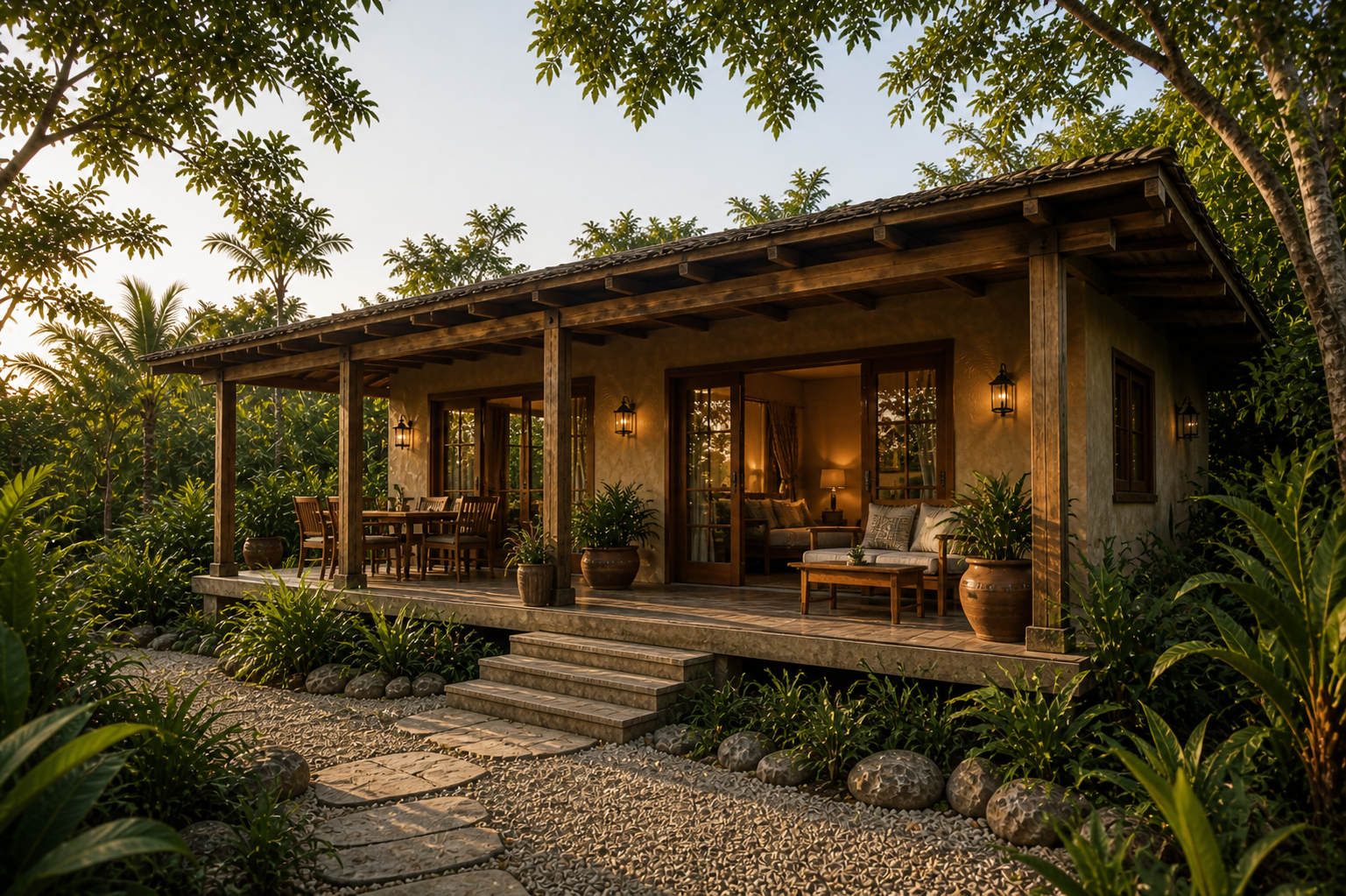
Casa Tierra.
Grounded. Spacious.
The largest casa,
closest to the earth.
Casa Tierra is the villa that families ask for by name before they have seen any of the others. It occupies the widest footprint on the reserve, a single-story structure that spreads outward rather than upward, keeping every room at ground level and every doorway within a few steps of the garden. The architects describe its relationship to the land as "flush." The floor inside meets the soil outside at the same elevation, separated only by a hand-poured concrete threshold that wears down a little more each season. This is a house that does not sit on the earth. It sits with it.
The palette of Casa Tierra draws entirely from the ground beneath it. Walls are finished in a rammed earth technique using soil excavated during the villa's own foundation work, mixed with volcanic aggregate from the Sierra Madre del Sur and stabilized with a minimal amount of lime. The result is a surface that shows visible strata: bands of ochre, sienna, and dark brown that read like a geological cross-section of the Oaxacan coast. No two walls look alike because no two sections of earth were composed of the same layers.
The floor plan is arranged around a central courtyard open to the sky, a design borrowed from the traditional hacienda but scaled down to the proportions of a family home. Two bedrooms sit on one side of the courtyard, separated by a shared bathroom with a deep concrete tub and a double vanity carved from a single slab of cantera stone. The main living area faces the courtyard from the opposite side, with a long dining table made from reclaimed mesquite, a daybed wide enough for three children, and an open kitchen with a wood-burning clay oven built into the wall.
The garden that surrounds Casa Tierra is not ornamental. It is the reserve's primary kitchen garden, planted with herbs, greens, chiles, and fruit trees that supply the communal kitchen daily. Guests staying here are invited to pick what they need directly: epazote for evening quesadillas, limes for morning water, guava for the children. The boundary between accommodation and agriculture dissolves here in a way that is central to what Montserrat Reserve is trying to build. Staying at Casa Tierra means living, briefly, inside the food system rather than beside it.
Built from the ground up.
Rammed Earth Walls
Built using soil from the villa's own foundation, mixed with volcanic aggregate and stabilized with lime. Visible strata of ochre, sienna, and dark brown create a surface that reads like the geology of the coast. No two walls share the same pattern.
Central Courtyard
An open-air courtyard at the center of the floor plan, inspired by traditional hacienda proportions. Two bedrooms on one side, the living area on the other. The sky overhead. The garden on all sides. A family gathers here naturally without being forced into a single room.
Working Kitchen Garden
The reserve's primary kitchen garden wraps around the villa. Herbs, greens, chiles, lime trees, and guava grow within arm's reach. Guests pick what they need for meals. The garden is not a feature of the house. The house is a feature of the garden.
Clay Oven Kitchen
An open kitchen with a wood-burning clay oven built into the rammed earth wall. A long mesquite dining table seats six comfortably. A daybed wide enough for three children sits beneath the window. Meals happen here the way they happen in Oaxacan homes: slowly, together, with hands.
What it feels like
to stay as a family.
The morning routine at Casa Tierra begins in the garden. Children figure this out before adults do. Within a day of arriving, they have identified the guava tree with the ripest fruit, the herb row where basil grows tall enough to hide behind, and the stone path that leads from the courtyard to the natural pool without passing through any doorway. The adults follow at their own pace, coffee in hand, stepping from the kitchen threshold directly onto the soil without a transition.
Breakfast at Casa Tierra is the meal that defines the stay. The clay oven retains heat from the previous evening, warm enough to toast tortillas and heat a comal for eggs collected that morning from the reserve's small coop. Fresh herbs go from the garden into the pan in under a minute. Lime juice, squeezed from the tree ten meters from the kitchen, goes into a pitcher of water that stays on the mesquite table until lunch. There is no menu and no schedule. You cook what the garden offers and you eat when you are ready.
Evenings settle into the courtyard. The children lie on the daybed with books or drawing supplies while the adults sit at the table with mezcal or agua fresca. The courtyard traps warmth from the day and releases it slowly after sunset, keeping the temperature comfortable long after dark. Stars appear overhead through the open roof. Sounds narrow to crickets and the distant rhythm of the coast. There is enough space at Casa Tierra for a family to spread out and enough intimacy in its courtyard design to bring them back together when the day ends.
What's included.
- Two bedrooms with organic cotton linens
- Full kitchen with wood-burning clay oven
- Daily harvest access to the kitchen garden
- Farm eggs and fresh tortillas each morning
- Central courtyard open to the sky
- Deep concrete soaking tub
- Long mesquite dining table seating six
- Daybed for children or reading
- Direct garden-level access to natural pool
- Children's nature activity kit
- Walking path to the beach
- Garden tour with reserve caretaker
Bring the family
closer to the land.
Waitlist members receive priority booking and founding guest pricing for Casa Tierra and all five casas at Montserrat Reserve.