Sustainability at Montserrat Reserve is not a marketing label. It is a design principle that shaped every decision, from the foundation of the villas to the seeds in the garden. We are not trying to minimize our footprint. We are trying to leave the land better than we found it.
Most eco retreats talk about reducing harm. We are interested in something different: regeneration. That means designing systems that actively restore the land, the water, and the soil rather than simply consuming less of them.
The philosophy behind Montserrat Reserve draws from permaculture, traditional Oaxacan building practices, and contemporary regenerative design. Every element on the property is connected. The gardens feed the guests and the compost. The compost feeds the soil. The soil feeds the trees. The trees shade the buildings and cool the air. The rainwater flows from roofs into cisterns, from cisterns into irrigation, and from irrigation back into the earth.
This is not a closed loop, because nature does not work in closed loops. It is a spiral, where each cycle leaves the system a little richer, a little more alive, a little more capable of sustaining itself without external inputs. We are not building a resort on top of nature. We are weaving a place to stay into the fabric of an ecosystem that was here long before we arrived and will be here long after.
This approach takes more time, more thought, and more willingness to let the land dictate the design. But the result is a place that feels fundamentally different from a conventional hotel, because it is.
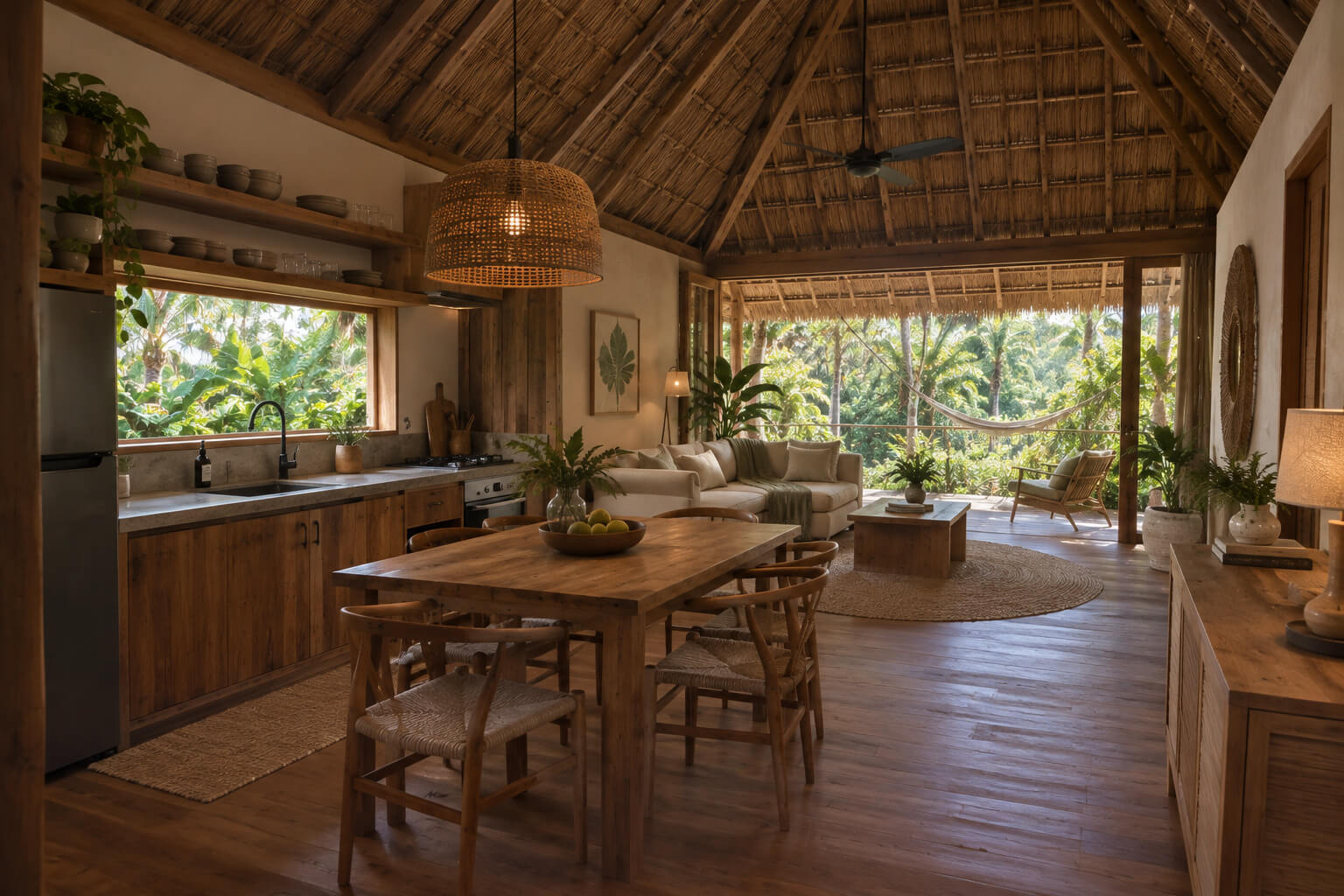
The villas and common areas at Montserrat Reserve are constructed primarily from materials found on or near the property. Local hardwoods, harvested responsibly and dried naturally, form the structural frames and the furniture. Stone pulled from the terrain shapes the foundations, the pool, and the pathways. Earth-based plasters made from local clay and sand coat the walls, providing natural insulation that keeps interiors cool during the day and warm at night.
The roofs are designed to breathe. Open eaves allow air to circulate while overhangs protect from rain. The palapa-style structures use dried palm fronds, a traditional coastal roofing material that is renewable, naturally waterproof, and remarkably effective at regulating temperature. Where palm is not suitable, we use terracotta tiles fired locally.
There is very little concrete on the property. Where it was necessary for structural integrity, we used it sparingly and mixed it with local aggregate to reduce the carbon cost. Metal hardware is minimal and sourced from regional workshops. The aesthetic is not designed to look natural. It is natural, because the materials themselves dictate the form, the color, and the texture of every surface you see and touch.
Building this way is slower than conventional construction. It requires craftspeople who understand traditional techniques, patience with drying times and curing processes, and a willingness to let the material lead the design. But the result is architecture that belongs to its place, not imported from somewhere else.
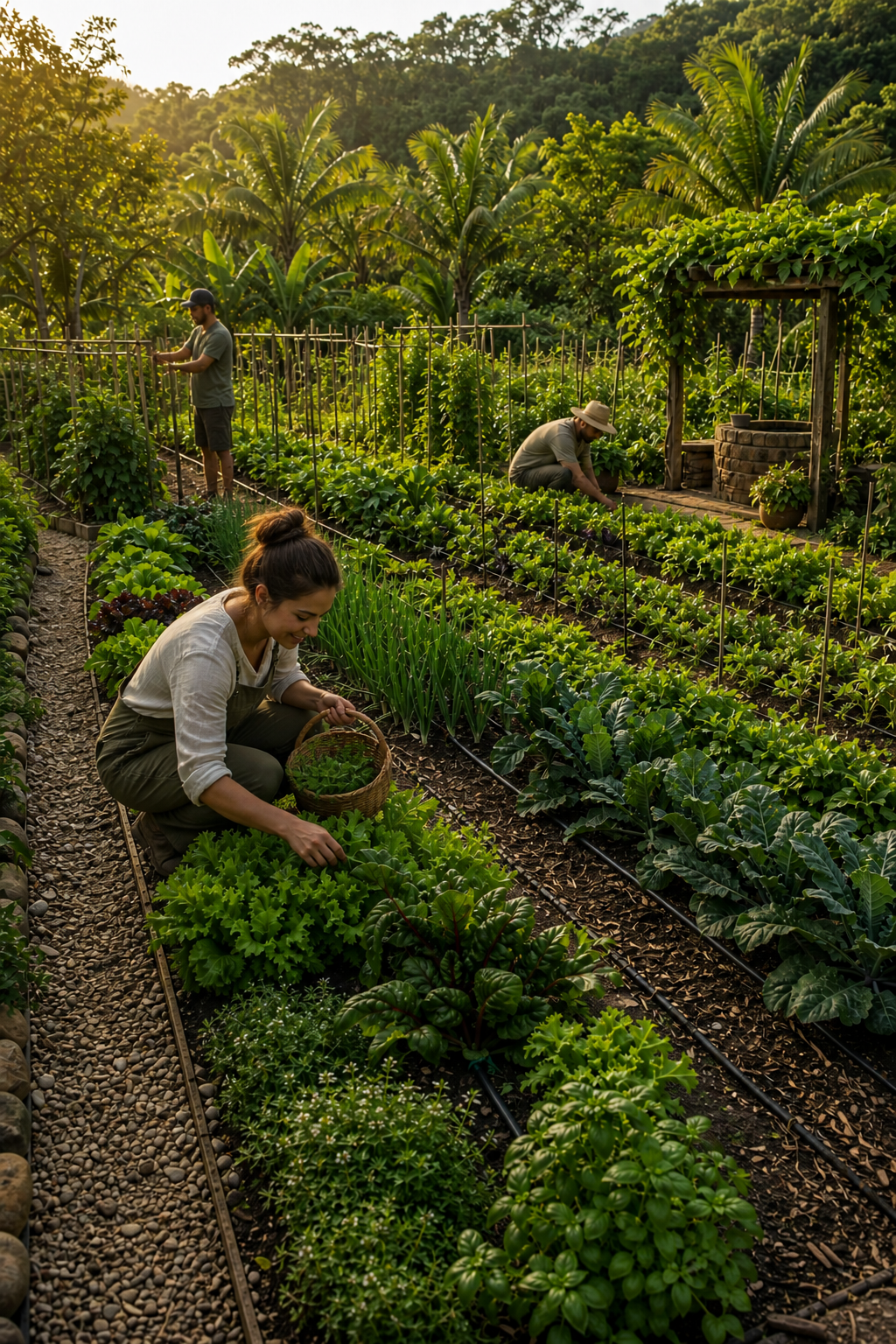
The gardens at Montserrat Reserve are not decorative. They are productive. Based on permaculture principles, the garden system is designed to mimic natural ecosystems, layering plants by height, function, and relationship so that each species supports the others.
Tall fruit trees provide shade for understory plants. Ground covers suppress weeds and retain moisture. Nitrogen-fixing plants enrich the soil for their neighbors. Companion planting discourages pests without chemicals. The result is a garden that requires less water, less intervention, and less maintenance than a conventional plot, while producing more diverse and flavorful food.
What grows here depends on the season. During the wet months, the garden overflows with squash, tomatoes, chiles, herbs, and leafy greens. In the dry season, hardier crops take over: root vegetables, drought-resistant herbs, and the ever-present citrus and papaya trees that produce year-round. The orchard includes banana, mango, coconut, and guava.
All organic waste on the property, kitchen scraps, garden trimmings, fallen leaves, is composted on-site and returned to the soil. The composting system uses both hot composting for quick turnover and vermicomposting with red wigglers for nutrient-rich castings. This closes the nutrient cycle and means we never need to import fertilizer.
The two most critical resources at Montserrat Reserve are water and energy. Both are managed through systems designed to work with the climate, not against it.
Some guests arrive expecting sustainability to mean sacrifice. Shorter showers. Dim lighting. Bland food. The experience at Montserrat Reserve is the opposite. Because the systems here are designed thoughtfully, the result is not less comfort, it is a different kind of comfort, one that feels better precisely because you know it is not coming at a cost to the place around you.
The water in the natural pool is softer on your skin than chlorinated water. The food from the garden tastes better because it was picked that morning, grown in rich soil without chemicals, and prepared by someone who knew the plant when it was a seed. The air inside the villas is cooler and cleaner because the walls are made of clay and the roof breathes, not because an air conditioning unit is burning energy to fight the heat.
The quiet you experience here is not enforced. It is a consequence of design choices: no generators humming, no HVAC system cycling, no machinery running in the background. The sounds you hear are real: wind, water, insects, birds, and the occasional distant crash of a wave on the shore.
We do not ask guests to compromise. We ask them to notice. To notice that the light at dinner comes from candles and solar-powered fixtures and that it is more beautiful than fluorescent overheads. To notice that the coffee tastes different when it is brewed without the hum of a Keurig. To notice that sleep comes easier in a room where the temperature is regulated by earth and air rather than electronics.
This is what sustainability feels like when it is done well. Not deprivation. Not virtue signaling. Just a place that works the way the land wants it to, and that works for the people who come to stay.
Montserrat Reserve opens in 2026 with limited availability for founding guests. Join the waitlist for priority access and early pricing.
Join the WaitlistJoin the private waitlist for priority booking and founding guest pricing.